Double Platinum Spark Plug For American Cars Suppliers
information to be updated
High-Performance Double Platinum Spark Plugs for American Engines Specially engineered for American powertrains, these double platinum spark plugs utilize dual platinum electrode technology to synergistically enhance corrosion resistance and minimize electrode wear. This ensures consistent ignition stability while delivering excellent abrasion resistance and thermal stability, effectively balancing the dual demands of extended service life and environmental compliance for American vehicles. The design maintains ignition efficiency in strict accordance with original engineering specifications.
Featuring a dual precious metal configuration with platinum center and ground electrodes, these plugs guarantee reliable ignition performance compatible with high-frequency start-stop cycles and high-load conditions in American engines. They ensure stable operation in congested urban driving environments, offering a service life of 60,000-80,000 kilometers that significantly reduces replacement frequency. With their dual platinum construction and optimized compatibility with American vehicle specifications, these spark plugs represent an ideal cost-effective, long-term maintenance solution for American automobile owners.
About Us
Ningbo Zhongxuan Electronic Technology Co., Ltd
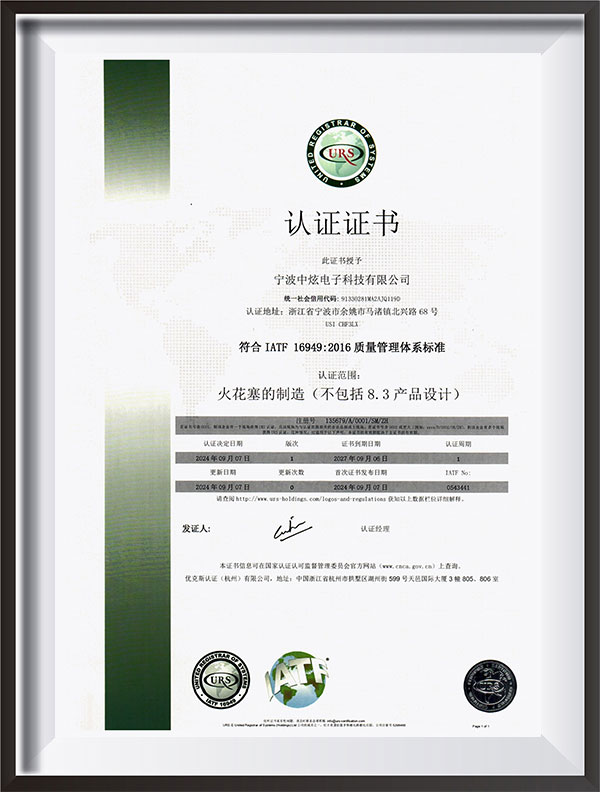
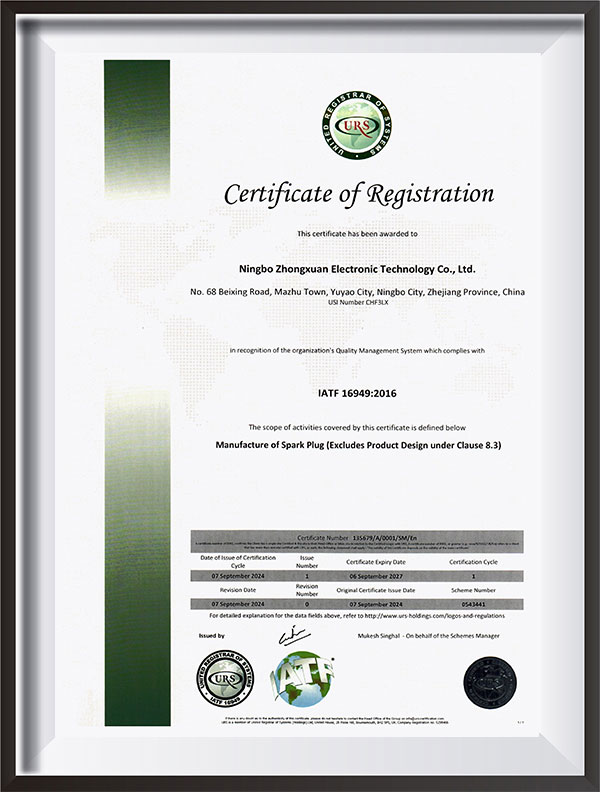
As China OEM Double Platinum Spark Plug For American Cars Suppliers and ODM Double Platinum Spark Plug For American Cars Factory, The company is a high-end automotive spark plug professional manufacturer.The existing standard workshop is more than 12000 square meters, a number of advanced complete automatic production lines, production capacity and production technology has reached the industry leading level. The enterprise has passed the lATF 16949 quality management system standard, lSO9001,and other system certification.
The company has mature Japanese cold sealing technology and galvanizing technology, nickel to ensure superior product performance and exquisite appearance.Also with many years of research and development experience in turbocharged special spark plug technology.
The production of iridium, platinum, double platinum, iridium platinum, double iridium and other precious metal car special type spark plug, over 330 types.Annual output is more than 20,000,000 pcs.The company has more than 90 R&D sales and after-sales personnel. The product quality is constantly improved after years of research and development.
At present, the company has become partner with many domestic auto parts brand chain enterprises, large auto parts dealers, and OEM customization for products with influence brand in China.At the same time, the company cooperate with the world's top three OES company, the products are exported to Germany,Poland.Russia.United States and so on.
If you are comparing a heat range 6 and a heat range 7 spark plug for the same engine, the direct answer is that the 6 is one step hotter and the 7 is one step colder. The 7 keeps the electrode tip roughly 70-100°C cooler at the same engine load, which gives a larger safety margin against pre-ignit...
A spark plug gap that is too small produces a short, weak spark that cannot ignite the air-fuel mixture reliably. In ordinary driving this shows up as a rough idle, hesitation when you press the throttle, a measurable drop in fuel economy, and often a flashing or steady check-engine light with a mi...
Selecting the heat range of a spark plug is not a performance upgrade. It is a combustion tuning decision that affects engine reliability. The heat range controls how quickly the firing tip sheds heat into the cylinder head, and the correct heat range keeps that tip between 500°C and 800°C (932°F t...
Please feel free to leave a message and we will reply to you soon.
Industry knowledge
The double platinum spark plug for American cars represents a significant step forward in ignition technology, designed specifically to meet the demanding performance requirements of domestic V6 and V8 engines found in trucks, SUVs, and full-size sedans. Unlike conventional copper-core plugs, double platinum variants place a platinum disc on both the center electrode and the ground electrode, dramatically reducing electrode wear and extending service life to up to 100,000 miles under normal driving conditions. This dual-platinum design is especially well-suited to the coil-on-plug ignition systems common in modern American vehicles, where the firing pattern alternates between electrodes depending on engine cycle — a condition that would quickly erode a single-platinum or copper plug.
Why American Engines Benefit From Dual-Electrode Platinum Protection
Large-displacement American engines — think the 5.3L EcoTec3, the 3.5L EcoBoost, or the 5.7L HEMI — operate at combustion temperatures and pressures that chew through electrode material faster than smaller-displacement imports. The ground electrode, in particular, faces repeated quenching cycles as it sits close to the combustion chamber wall, pulling heat away and causing oxidation. A single platinum cap on the center electrode alone won't address this.
With platinum on both electrodes, the spark gap widens much more slowly over time. A wider gap means a weaker, inconsistent spark — leading to misfires, rough idle, and fuel waste. Studies on fleet vehicles show that worn spark plugs can reduce fuel efficiency by 4–8%, a significant number across tens of thousands of miles. Keeping the gap stable with a double platinum construction directly preserves the ignition event quality throughout the plug's service life.
NINGBO ZHONGXUAN ELECTRONIC TECHNOLOGY CO., LTD brings years of research into turbocharged special spark plug technology to this product category — an increasingly relevant capability as American automakers have shifted toward smaller-displacement, turbocharged engines to meet fuel economy targets without sacrificing power output.
Electrode Gap Growth After 60,000 Miles (mm, Estimated Average)
Gap growth data based on internal industry benchmarks; lower values indicate better electrode longevity.
How Cold Sealing Technology Affects Long-Term Plug Reliability
One underappreciated factor in spark plug longevity — particularly in American truck and SUV applications — is the quality of the seal between the ceramic insulator and the metal shell. A compromised seal allows combustion gases to leak, creates heat transfer irregularities, and in worst cases can cause the plug to loosen under engine vibration. This is a real field problem on high-torque V8s where engine vibration is substantially greater than four-cylinder applications.
The manufacturing process matters here. Mature Japanese cold sealing techniques — the approach used in production at NINGBO ZHONGXUAN ELECTRONIC TECHNOLOGY CO., LTD — create a mechanically tight bond at ambient temperature rather than relying on heat-shrink or adhesive methods that can degrade over thermal cycles. Combined with nickel and galvanizing treatment on the shell exterior, the result is a plug that resists corrosion and thread seizure — a common complaint with American vehicles operating in salt-belt states or high-humidity environments.
Shell Protection
Nickel-plated exterior
Galvanized corrosion barrier
Cold-sealed insulator joint
Electrode Technology
Platinum center disc
Platinum ground electrode tip
Stable gap over full service life
Production Scale and What It Means for Sourcing
For distributors and aftermarket suppliers stocking double platinum spark plug for American cars, production consistency and lead time are as important as the plug's technical spec. A plug that performs well in a lab sample but varies batch-to-batch creates warranty headaches downstream.
With a fully automated production line covering over 12,000 square meters and an annual output capacity of up to 18 million pieces, NINGBO ZHONGXUAN ELECTRONIC TECHNOLOGY CO., LTD operates at a scale that supports consistent process control across every production run. Automation reduces human variation — the enemy of electrode gap consistency and platinum bonding quality.
For standard orders, production and shipment typically complete within 15–30 days after deposit confirmation. Larger or customized orders are scheduled with a specific timeline provided upfront — a process detail that matters when you're planning a seasonal inventory build or filling a container for a specific vehicle application range.
Manufacturing Capability Overview
Selecting the Right Heat Range for American Car Applications
Heat range is the single most consequential selection variable when specifying a double platinum spark plug for American cars. Too cold a heat range and carbon deposits build on the insulator nose; too hot and pre-ignition risk increases sharply in a high-compression or boosted engine.
American OEM specifications are more varied than many European or Japanese platforms, spanning everything from naturally aspirated 3.6L V6s in crossovers to 6.2L supercharged V8s in performance applications. Each calls for a different heat range number — and these numbers are not cross-compatible between manufacturers without referencing an interchange chart.
Application Type
Typical Heat Range
Risk if Wrong
Daily commuter V6
Standard (mid-range)
Low if correctly matched
Turbocharged 4-cyl / V6
Colder than standard
Pre-ignition if too hot
High-output V8 (performance)
Colder range, tighter gap
Engine knock risk
Towing / truck V8
Standard to slightly hot
Carbon fouling if too cold
Heat range selection guide by American car application type.
Common Questions About Double Platinum Spark Plugs for American Cars
Can I use a double platinum plug in a vehicle that originally came with copper plugs?
Generally yes, provided the thread size, reach, and heat range match the OEM specification. Double platinum plugs are backward-compatible with most American vehicles running standard ignition systems. The main practical difference is that you won't need to replace them as frequently — which also means the initial purchase cost per plug is higher, but the per-mile cost works out favorably over time.
Are double platinum plugs worth it compared to iridium for American V8s?
Iridium has a higher melting point (2,447°C vs. 1,768°C for platinum) and can handle a finer electrode tip, producing a more focused spark. For high-boost turbo applications, iridium may have a performance edge. For the majority of naturally aspirated American V8s and V6s, double platinum delivers comparable longevity with a more accessible price point — a reasonable trade-off for fleet operators and value-focused consumers.
How do I know if my double platinum plugs need replacement?
Common indicators include rough idle, noticeably reduced acceleration response, increased fuel consumption, and occasional misfires flagged by a check engine light (OBD-II codes P0300–P0308 on most American vehicles). Visually, a worn double platinum plug typically shows a widened and rounded electrode tip where the platinum disc has eroded. If the gap has grown more than 0.02–0.03 inches beyond the OEM spec, replacement is warranted regardless of mileage.
What is the typical torque spec when installing plugs in American car cylinder heads?
Most American aluminum cylinder heads specify 13–15 ft-lb for 14mm plugs and slightly less for 12mm variants. Over-torquing is a common installer error that can damage the thread in aluminum heads — a repair that costs far more than a new set of plugs. Always use a torque wrench; never install by feel alone on aluminum applications.
Can double platinum plugs be gapped to a custom setting?
Pre-set gap from the factory should be verified but not aggressively adjusted — the platinum disc on the center electrode is bonded, and bending the electrode to change gap risks cracking or delaminating the platinum tip. Minor verification with a feeler gauge is fine. If the supplied gap is more than 0.004 inches off the target spec, it's better to select a correctly-gapped variant from the product range than to risk damaging the electrode construction.



 Español