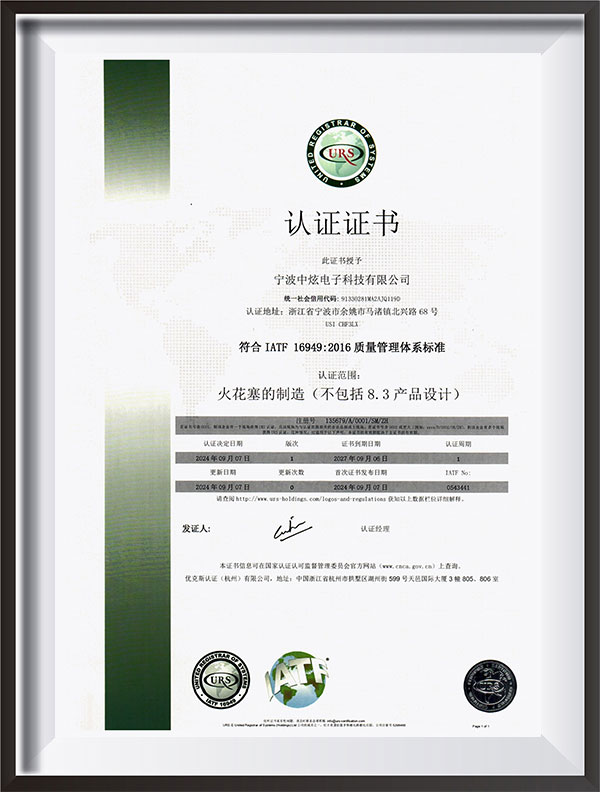
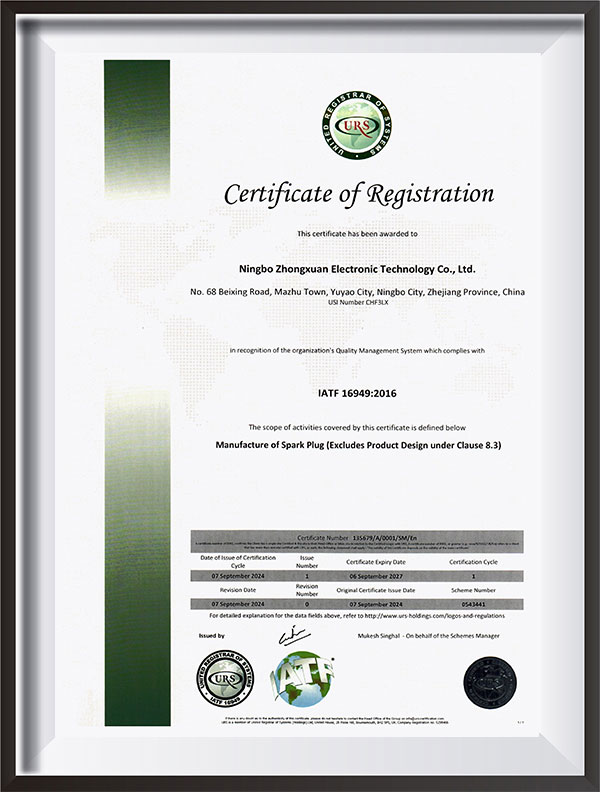
As China OEM Platinum Spark Plug For other cars Suppliers and ODM Platinum Spark Plug For other cars Factory, The company is a high-end automotive spark plug professional manufacturer.The existing standard workshop is more than 12000 square meters, a number of advanced complete automatic production lines, production capacity and production technology has reached the industry leading level. The enterprise has passed the lATF 16949 quality management system standard, lSO9001,and other system certification.
The company has mature Japanese cold sealing technology and galvanizing technology, nickel to ensure superior product performance and exquisite appearance.Also with many years of research and development experience in turbocharged special spark plug technology.
The production of iridium, platinum, double platinum, iridium platinum, double iridium and other precious metal car special type spark plug, over 330 types.Annual output is more than 20,000,000 pcs.The company has more than 90 R&D sales and after-sales personnel. The product quality is constantly improved after years of research and development.
At present, the company has become partner with many domestic auto parts brand chain enterprises, large auto parts dealers, and OEM customization for products with influence brand in China.At the same time, the company cooperate with the world's top three OES company, the products are exported to Germany,Poland.Russia.United States and so on.
If you are comparing a heat range 6 and a heat range 7 spark plug for the same engine, the direct answer is that the 6 is one step hotter and the 7 is one step colder. The 7 keeps the electrode tip roughly 70-100°C cooler at the same engine load, which gives a larger safety margin against pre-ignit...
A spark plug gap that is too small produces a short, weak spark that cannot ignite the air-fuel mixture reliably. In ordinary driving this shows up as a rough idle, hesitation when you press the throttle, a measurable drop in fuel economy, and often a flashing or steady check-engine light with a mi...
Selecting the heat range of a spark plug is not a performance upgrade. It is a combustion tuning decision that affects engine reliability. The heat range controls how quickly the firing tip sheds heat into the cylinder head, and the correct heat range keeps that tip between 500°C and 800°C (932°F t...
Please feel free to leave a message and we will reply to you soon.
Industry knowledge
Platinum spark plugs have become a go-to ignition component across a remarkably wide range of vehicles — from everyday commuter sedans and SUVs to light trucks and fleet cars. Unlike copper plugs that rely on a soft nickel-alloy tip, a platinum spark plug features a platinum disc fused to the center electrode, giving it superior hardness and heat tolerance. For cars that don't fall into a single-brand OEM program — often categorized as "other cars" in the aftermarket world — choosing the right platinum plug means matching heat range, thread size, and electrode design to the engine's specific requirements. This is where deep product knowledge and manufacturing consistency really matter.
Why Platinum Works Differently from Copper and Nickel Plugs
The physics behind platinum's performance advantage comes down to two properties: hardness and melting point. Platinum melts at approximately 3,215°F (1,769°C), far above what a typical combustion chamber reaches during normal operation. Copper-core plugs with nickel-alloy tips start eroding more quickly at high temperatures, which widens the electrode gap over time — and a wider gap means the ignition coil must work harder to fire a spark.
Platinum's hardness means the electrode tip retains its shape far longer. This directly impacts spark consistency: a well-maintained gap produces a reliable arc on every cycle, which leads to steadier idle, smoother cold starts, and more predictable ignition timing as mileage accumulates.
Typical Service Life by Spark Plug Type (miles)
Copper / Nickel
~20,000 mi
Single Platinum
~60,000 mi
Double Platinum
~90,000 mi
Iridium
100,000+ mi
Source: Champion Auto Parts, AutoZone industry data
There's also a thermal advantage: platinum runs slightly hotter at the tip, which actively burns off carbon deposits before they accumulate. This self-cleaning effect helps prevent fouling — a common failure mode in stop-and-go city driving.
Single vs. Double Platinum: Choosing the Right Configuration
Not all platinum plugs are built the same. The two main configurations behave differently in different ignition systems, and using the wrong one can cost performance.
Platinum plug types and their typical application scenarios
Type
Electrode Design
Best Suited For
Typical Lifespan
Single Platinum
Platinum tip on center electrode only
DIS (distributor-based) ignition systems
~60,000 miles
Double Platinum
Platinum on both center and side electrodes
Waste-spark ignition systems
~90,000 miles
In a waste-spark system, the spark fires in both directions — once toward the piston and once in reverse. A single platinum plug in this setup would quickly erode the side electrode because the platinum protection only covers the center. Double platinum prevents this by protecting both contact surfaces equally.
Fitment Across "Other Cars": What Actually Determines Compatibility
The phrase "for other cars" in the aftermarket describes the large category of vehicles that don't belong to a single OEM or a flagship model line. Think mid-size crossovers, older Asian-market imports, regional-spec sedans, or multi-market fleet vehicles. These cars often run on engines that share ignition specs with multiple platforms, making platinum plugs a versatile fit — but only when the following parameters match:
Thread size and reach — the physical dimensions of the plug body must match the cylinder head threading exactly
Heat range — this controls how fast the plug dissipates heat; the wrong range causes pre-ignition or fouling
Electrode gap — factory-specified gaps vary from around 0.028" to 0.060" depending on ignition system voltage
Resistor value — most modern cars require resistor plugs to suppress radio frequency interference from the ECU
According to one industry study, misaligned spark plug gap settings alone can reduce combustion efficiency by up to 20%, while a correctly gapped plug can improve fuel economy by approximately 1.5–2% (source: techiepowerparts.com industry analysis). These numbers matter in fleet management scenarios where even small efficiency gains multiply across hundreds of vehicles.
Performance Profile: Platinum vs. Other Plug Materials
Here's how platinum positions itself in a multi-dimensional view against copper and iridium — the other two dominant electrode materials in the aftermarket today.
Comparative performance profile — illustrative based on published industry characteristics
Platinum sits clearly between copper and iridium across most dimensions. Its real competitive advantage is cost-effectiveness combined with longevity — it outlasts copper by 3–5x while costing only modestly more ($4–$8 per plug versus $12–$14 for iridium, per AutoZone pricing data).
In the aftermarket world, "platinum spark plug for other cars" is a deceptively simple label for a product that demands tight manufacturing tolerances. The electrode gap must be held within fractions of a millimeter, the platinum disc weld must be metallurgically sound, and the ceramic insulator must meet exacting dielectric standards. This is where the difference between a reliable supplier and a generic one becomes tangible.
NINGBO ZHONGXUAN ELECTRONIC TECHNOLOGY CO., LTD operates with a factory infrastructure built specifically for this level of precision. Their laboratory strictly implements 17 international testing standards, covering everything from electrode gap tolerances to insulator breakdown voltage and high-temperature cycling behavior. For buyers sourcing platinum plugs for diverse vehicle applications, that testing depth means less field failure and fewer warranty claims.
The factory's sound facilities and full production functions make it particularly well-suited for mass production — an important consideration when fleet buyers or distributors are procuring plugs across dozens of vehicle fitments simultaneously. Consistent dimensional accuracy at scale is harder to achieve than it looks, and it's one of the benchmarks that separates a mature spark plug manufacturer from a subcontractor assembling parts.
What 17 Testing Standards Cover (Examples)
Electrode Gap Tolerance
Ensures firing precision within ±0.02mm
Insulator Dielectric Test
Validates ceramic breakdown voltage under load
Thermal Cycling
Simulates thousands of cold-start / hot cycles
Weld Bond Integrity
Confirms platinum disc adhesion under vibration
Supplying Platinum Plugs Across More Than 20 Markets
One of the practical challenges of selling platinum spark plugs for "other cars" is that vehicle populations differ dramatically by region. European markets skew toward turbocharged engines with tighter thermal requirements. North American fleets rely heavily on V8 platforms. Asian markets include a high volume of small-displacement commuter vehicles. The Middle East and South America present unique ambient temperature and fuel quality variables.
Europe
North America
Asia
Middle East
South America
20+ Countries Total
NINGBO ZHONGXUAN ELECTRONIC TECHNOLOGY CO., LTD has successfully exported to over 20 countries and regions across these territories. That market reach is more than a distribution achievement — it represents accumulated knowledge of what different markets actually require. Vehicle fitment databases, local ignition system preferences, and procurement standards differ between a European fleet buyer and a South American auto parts distributor. The team's familiarity with these distinctions means customers can ask about specific country requirements and get a substantive answer — not a generic product sheet.
If you inform them of your country, they can provide specific information on product adaptation and market-relevant experience. This kind of customer support is hard to replicate without genuine on-the-ground export history.
Installation Best Practices That Affect Long-Term Performance
Even a correctly specified platinum plug will underperform if installed carelessly. A few practical guidelines that matter in the field:
Torque to spec — not by feel. Most passenger car engines specify 10–15 lb-ft for spark plugs. Over-torquing can crack the ceramic insulator or strip the cylinder head threads; under-torquing leads to heat transfer issues and loose plugs.
Verify the gap before installation. Pre-gapped plugs can shift during shipping. Always check with a feeler gauge against the vehicle manufacturer's specification — not the plug manufacturer's generic default.
Clean threads and seating surface. Any debris in the bore can fall into the combustion chamber and cause damage. Use compressed air before removing the old plug.
Replace all plugs at the same time. Mixing worn and new plugs creates uneven combustion timing across cylinders, which can trigger misfire codes even if the new plugs are fine.
Check ignition wires and coils simultaneously. A degraded ignition coil will shorten plug life regardless of material. If the coil can't supply adequate voltage, even a platinum plug will misfire.
Frequently Asked Questions
Can I put platinum spark plugs in any car?
Not exactly any car, but a very wide range. If your vehicle originally came with copper or nickel-alloy plugs, upgrading to platinum is generally fine and can extend service intervals significantly. However, if your car was factory-fitted with iridium plugs, you should not downgrade to platinum — the manufacturer's choice reflects the ignition system's voltage output and timing design. Always check the owner's manual or the OEM spec sheet first.
How do I know if platinum plugs are improving my fuel economy?
The improvement is real but modest — typically around 1.5% better fuel efficiency compared to worn or fouled copper plugs (source: industry analysis via techiepowerparts.com). A more visible signal is smoother idle, faster cold starts, and fewer hesitations under acceleration. If you're replacing plugs that were already very worn, the performance difference will feel more noticeable than the measured fuel savings.
Is double platinum always better than single platinum?
It depends on the ignition system, not the vehicle's age or size. Double platinum is specifically designed for waste-spark ignition systems, where the spark fires in both directions and would otherwise erode the side electrode quickly. In a standard DIS system, single platinum is the correct choice. Using double platinum in a non-waste-spark system won't cause damage, but it's unnecessary cost. Match the plug type to the ignition architecture, not to a general sense of "more is better."
Why do heat range numbers mean different things across brands?
There's no universal heat range numbering standard in the spark plug industry. One manufacturer's numbering runs hot-to-cold in ascending order; another does the exact opposite. This means you can't compare a heat range number from one brand directly to another. Always cross-reference using the vehicle OEM specification or a known cross-reference chart specific to the manufacturer. When sourcing aftermarket platinum plugs for diverse vehicle fitments, working with a supplier that understands these cross-reference nuances — as NINGBO ZHONGXUAN ELECTRONIC TECHNOLOGY CO., LTD does across its 20+ export markets — avoids costly fitment errors.
How often should platinum spark plugs be replaced?
Single platinum plugs typically last around 60,000 miles; double platinum variants can reach 90,000 miles under normal conditions. However, driving style, fuel quality, and engine condition all affect actual lifespan. In vehicles that spend a lot of time idling — delivery vehicles, rideshare cars, or city taxis — replacement intervals should be checked earlier. A visual inspection at around 50,000 miles can catch rounding or erosion of the center electrode tip before it causes misfires.



 Español