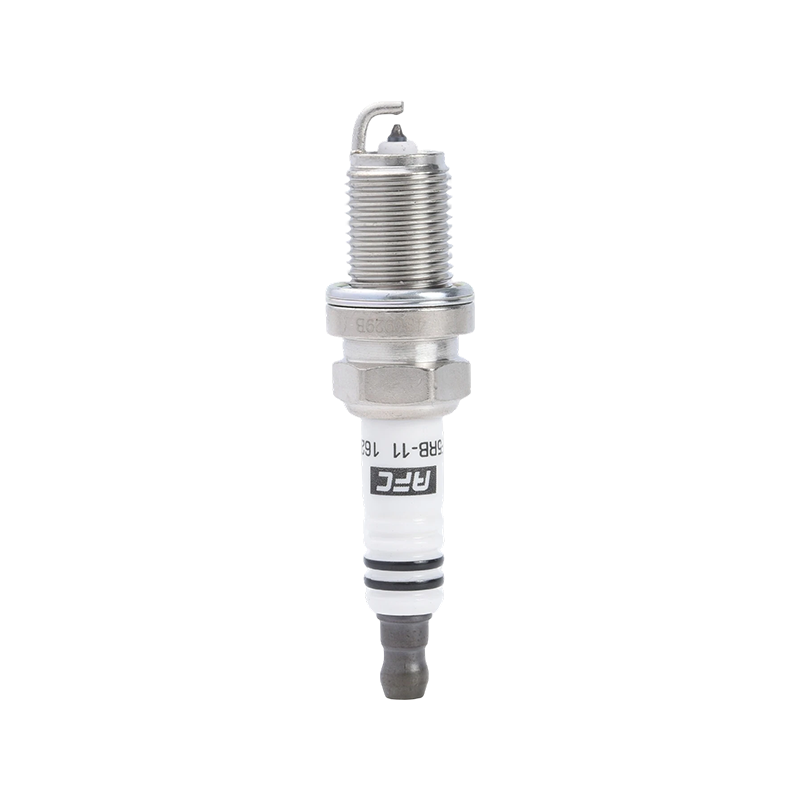
High-Performance Double Platinum Spark Plugs for Japanese Engines Specially engineered for Japanese vehicles, these double platinum spark plugs deliver precise compatibility with Subaru and other Japanese models. The series utilizes dual platinum electrode technology, where the synergistic effect of dual precious metals enhances corrosion resistance and minimizes electrode wear. This ensures consistent ignition stability while providing exceptional abrasion resistance and thermal stability, effectively balancing explosive power with long-term durability to meet Japanese vehicles' comprehensive requirements for extended service life and environmental compliance. The design maintains ignition efficiency in strict accordance with original factory specifications.
Featuring a dual precious metal configuration with platinum center and ground electrodes, these plugs are tailored for high-compression ratio designs in Japanese engines. They support stable operation in congested urban driving conditions, offering a service life of 60,000-80,000 kilometers that significantly reduces replacement frequency. With their dual platinum construction and perfect compatibility with Japanese vehicle specifications, these spark plugs represent an ideal cost-effective, long-term maintenance solution for Japanese automobile owners.
About Us
Ningbo Zhongxuan Electronic Technology Co., Ltd
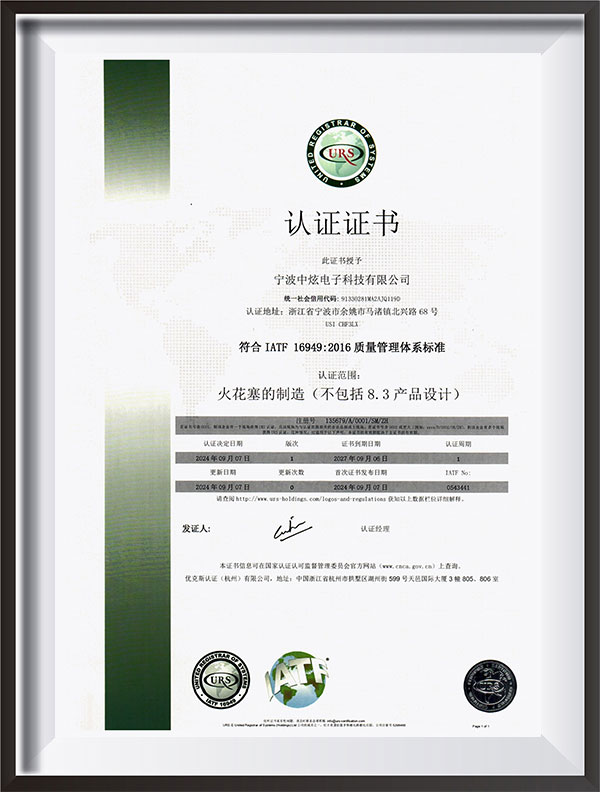
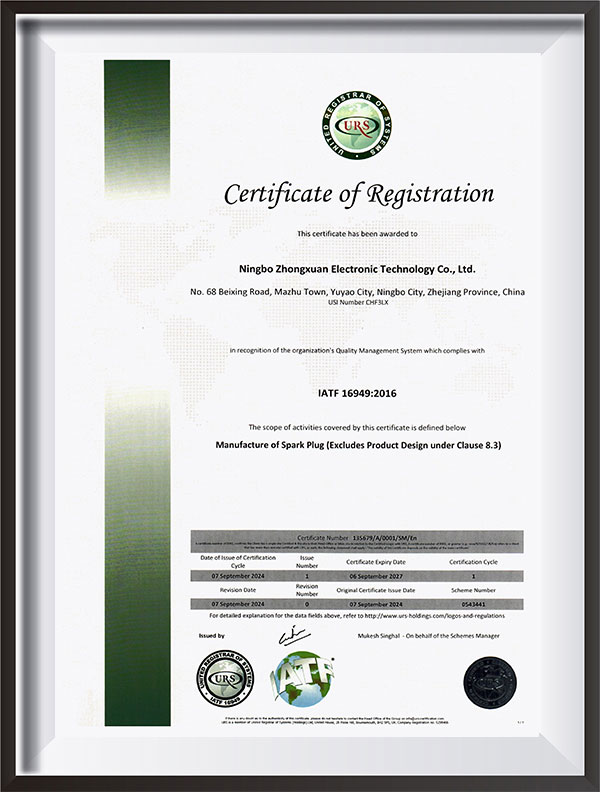
As China OEM Double Platinum Spark Plug For Japanese Cars Suppliers and ODM Double Platinum Spark Plug For Japanese Cars Factory, The company is a high-end automotive spark plug professional manufacturer.The existing standard workshop is more than 12000 square meters, a number of advanced complete automatic production lines, production capacity and production technology has reached the industry leading level. The enterprise has passed the lATF 16949 quality management system standard, lSO9001,and other system certification.
The company has mature Japanese cold sealing technology and galvanizing technology, nickel to ensure superior product performance and exquisite appearance.Also with many years of research and development experience in turbocharged special spark plug technology.
The production of iridium, platinum, double platinum, iridium platinum, double iridium and other precious metal car special type spark plug, over 330 types.Annual output is more than 20,000,000 pcs.The company has more than 90 R&D sales and after-sales personnel. The product quality is constantly improved after years of research and development.
At present, the company has become partner with many domestic auto parts brand chain enterprises, large auto parts dealers, and OEM customization for products with influence brand in China.At the same time, the company cooperate with the world's top three OES company, the products are exported to Germany,Poland.Russia.United States and so on.
If you are comparing a heat range 6 and a heat range 7 spark plug for the same engine, the direct answer is that the 6 is one step hotter and the 7 is one step colder. The 7 keeps the electrode tip roughly 70-100°C cooler at the same engine load, which gives a larger safety margin against pre-ignit...
A spark plug gap that is too small produces a short, weak spark that cannot ignite the air-fuel mixture reliably. In ordinary driving this shows up as a rough idle, hesitation when you press the throttle, a measurable drop in fuel economy, and often a flashing or steady check-engine light with a mi...
Selecting the heat range of a spark plug is not a performance upgrade. It is a combustion tuning decision that affects engine reliability. The heat range controls how quickly the firing tip sheds heat into the cylinder head, and the correct heat range keeps that tip between 500°C and 800°C (932°F t...
Please feel free to leave a message and we will reply to you soon.
Industry knowledge
In the world of automotive ignition, the double platinum spark plug for Japanese cars has become the go-to choice for owners and technicians who want reliable cold starts, cleaner combustion, and extended service intervals without compromising engine performance. Japanese automakers—spanning compact city cars to high-revving sport coupes—have long specified tighter ignition tolerances than most Western counterparts, making plug material and electrode geometry critical. Platinum on both the center and ground electrode creates a self-cleaning spark path that resists fouling, reduces misfires under urban stop-and-go conditions, and maintains consistent gap dimensions across 60,000–100,000 miles of service.
Why Double Platinum Works Differently in Japanese Engines
Japanese engines are built around high compression ratios, lean burn strategies, and variable valve timing systems. These design choices demand a spark plug that fires reliably across a wide range of air-fuel mixtures and RPM bands. The single-platinum plug—where only the center electrode carries a platinum pad—works fine in most scenarios, but wasted spark ignition systems (common on many inline-four engines from Toyota, Honda, Nissan, and Mitsubishi) fire the plug twice per cycle. That means the ground electrode takes just as much erosion as the center. Double platinum addresses this directly: both electrodes get a platinum alloy disc, balancing wear between the two firing surfaces.
The practical result is a more symmetrical wear pattern that keeps the spark gap within specification for longer. When a gap drifts beyond 0.05 mm above the OEM setting, misfire rates rise measurably—on a four-cylinder running at idle, even a 5% misfire rate translates to rough running, elevated hydrocarbons in the exhaust, and catalyst overloading. Keeping the gap tight with platinum on both sides delays that degradation significantly.
Approximate Electrode Wear Rate at 60,000 Miles (relative erosion, lower = better)
Illustrative comparison based on published technical data from spark plug manufacturers' engineering guides.
Matching the Right Plug to the Right Japanese Model
Heat Range
The heat range number controls how quickly the plug dissipates combustion heat. A plug that runs too hot pre-ignites the mixture; too cold and it fouls with carbon. Japanese OEM specifications typically fall in a narrow band—always cross-reference the plug's heat range against the OEM number, not just the vehicle year.
Thread Reach
Japanese cylinder heads are often aluminium alloy with relatively shallow thread bores. Installing a plug with even 2–3 mm of excess reach can contact a piston at TDC on high-compression engines, causing catastrophic damage. Thread reach and seat type (tapered vs. gasket) must match exactly.
Electrode Gap Spec
Most Japanese passenger car engines from 2000 onward specify gaps in the 1.0–1.3 mm range, which suits coil-on-plug high-energy ignition. With double platinum plugs, the gap is usually pre-set at the factory and should not be adjusted manually—doing so risks cracking the platinum disc.
At NINGBO ZHONGXUAN ELECTRONIC TECHNOLOGY CO., LTD, our product catalogue covers fitment data for major Japanese platforms including Toyota (Corolla, Camry, RAV4), Honda (Civic, CR-V, Accord), Nissan (Altima, X-Trail, Sentra), and Mitsubishi (Outlander, Eclipse Cross), ensuring the right plug goes into the right engine without guesswork.
Platform
Common Engine
OEM Gap (mm)
Recommended Service Interval
Toyota Corolla (E170/E210)
2ZR-FE / M20A-FKS
1.1
60,000 mi / 100,000 km
Honda Civic (10th/11th Gen)
L15B7 / L15C1
1.0
60,000 mi / 100,000 km
Nissan Altima (L34)
QR25DE / KR20DDET
1.1
60,000 mi / 100,000 km
Mitsubishi Outlander (GF)
4B11 / 4B12
1.1
60,000 mi / 100,000 km
Representative fitment data for reference; always verify against OEM workshop manual before ordering.
Sourcing and Partnership Flexibility
For distributors, workshops, and aftermarket brand builders, the sourcing model matters as much as the product itself. Most buyers in this segment fall into one of three categories: those who need parts under their own label, those who need neutral stock for private-label resale, and those who prefer to sell an established manufacturer's brand directly.
OEM / ODM
Manufacturing under your brand and packaging. OEM covers production only; ODM adds full design support for electrode geometry, shell plating, and packaging artwork.
Own Brand
Distributors can sell the manufacturer's branded product directly without any development investment—useful for entering a new market quickly.
Neutral Packaging
White-box, unbranded packaging gives buyers maximum flexibility to brand, bundle, or resell as needed—popular with workshop chains and online resellers.
On payment and logistics: standard trade terms include FOB, CIF, or CNF, confirmed at the quoting stage. Batch production typically requires a 30% deposit upfront, with the balance settled against the Bill of Lading, and T/T is the primary payment method. For long-term, high-volume clients, more flexible arrangements can be discussed. Shipping is predominantly by sea—the factory sits only 35 km from Ningbo Port, making sea export straightforward; air freight via Ningbo Airport or Shanghai International Airport is available when deadlines are tight.
Performance at a Glance: Double Platinum vs. Alternatives
The chart below scores four plug types across five performance dimensions typically evaluated by workshop technicians and fleet managers sourcing parts for Japanese vehicles.
Radar scores are illustrative rankings based on aggregate workshop feedback and published technical comparisons.
The gap in longevity and misfire resistance is where double platinum spark plugs for Japanese cars earn their keep. Copper wins on raw upfront cost, but when labour is factored in—Japanese engines often require intake manifold removal to access rear-bank plugs—the longer service life of platinum plugs is clearly more economical over a vehicle's lifespan.
Common Questions from Buyers and Technicians
Can I re-gap a double platinum plug to adjust for a modified engine?
No—and this is one of the most common mistakes in the field. The platinum disc on the ground electrode is extremely thin (typically 0.4–0.8 mm). Bending the ground electrode to close or open the gap risks fracturing the disc or delaminating it from the steel body. Modified engines requiring a non-standard gap should use a different plug specification entirely, not a re-gapped platinum unit.
Is double platinum the same as iridium for Japanese engines?
They serve a similar purpose—extending service life and maintaining gap stability—but the electrode geometry and price point differ. Iridium allows a finer tip diameter (sometimes as small as 0.4 mm), which can improve ignitability slightly in lean mixtures. For most naturally aspirated Japanese passenger cars, double platinum provides comparable real-world performance at a lower cost per plug, making it the pragmatic choice for high-volume fleet maintenance or price-sensitive aftermarket channels.
What MOQ is typical when sourcing plugs for Japanese car fitments?
MOQ varies by partnership model. For OEM/ODM orders with custom packaging, volumes tend to be higher to justify tooling and print runs. Neutral-packaging orders carry more flexibility. At NINGBO ZHONGXUAN ELECTRONIC TECHNOLOGY CO., LTD, the specific MOQ is confirmed during the quoting stage alongside trade terms—reaching out early with fitment lists and target markets helps the team respond with a tailored proposal quickly.
How long does sea freight from Ningbo take to reach major aftermarket hubs?
Ningbo Port connects directly to most major ports. Transit time to the US West Coast is typically 14–18 days; to Rotterdam or Felixstowe, 25–30 days; to Dubai, around 18–22 days. For urgent restocking, air freight from Ningbo Airport or Shanghai International Airport can cut transit to 3–5 days, though at significantly higher freight cost per kilogram.
Do packaging materials support market-specific requirements (language, barcodes, recycling marks)?
Yes. All packaging materials can be fully customized—language, labelling, barcodes, and regional compliance markings. Whether you're distributing in North America, Europe, Southeast Asia, or the Middle East, the packaging is designed to your market's requirements, handled as part of the OEM/ODM or neutral-packaging arrangement.



 Español