Double Platinum Spark Plug For other cars Suppliers
information to be updated
About Us
Ningbo Zhongxuan Electronic Technology Co., Ltd
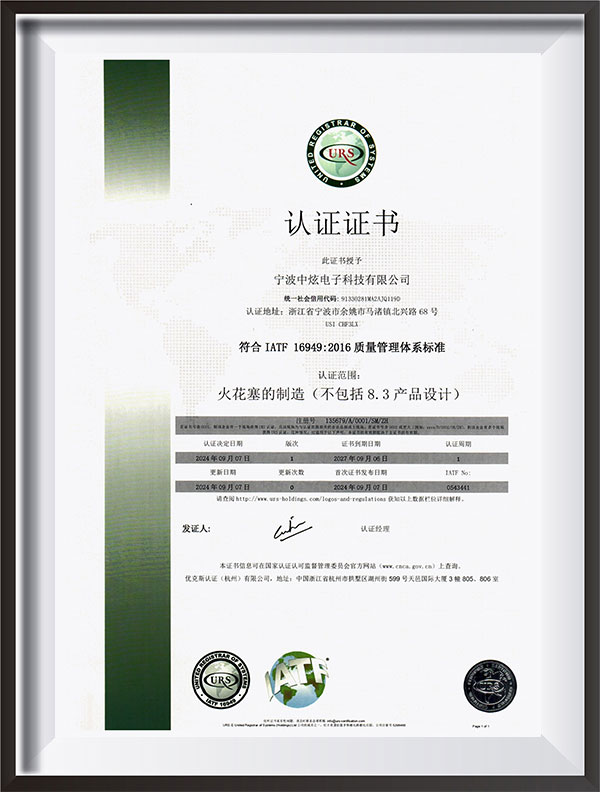
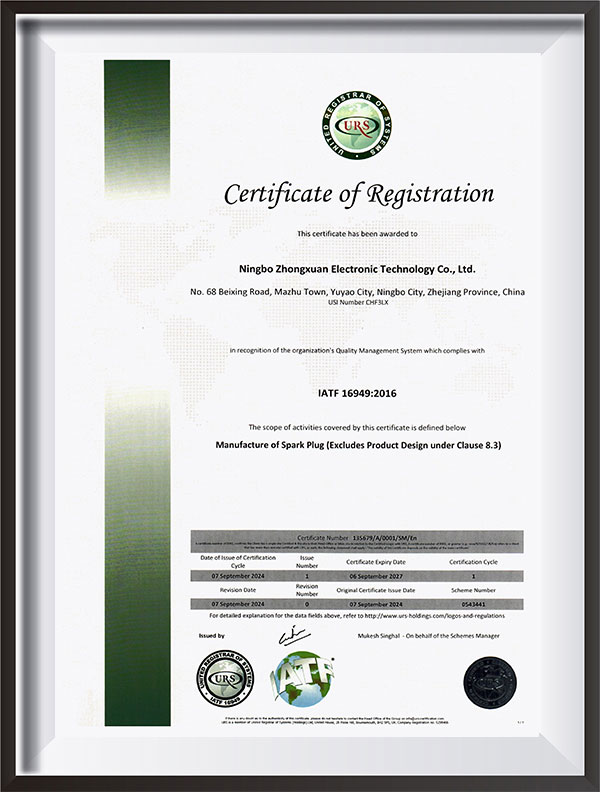
As China OEM Double Platinum Spark Plug For other cars Suppliers and ODM Double Platinum Spark Plug For other cars Factory, The company is a high-end automotive spark plug professional manufacturer.The existing standard workshop is more than 12000 square meters, a number of advanced complete automatic production lines, production capacity and production technology has reached the industry leading level. The enterprise has passed the lATF 16949 quality management system standard, lSO9001,and other system certification.
The company has mature Japanese cold sealing technology and galvanizing technology, nickel to ensure superior product performance and exquisite appearance.Also with many years of research and development experience in turbocharged special spark plug technology.
The production of iridium, platinum, double platinum, iridium platinum, double iridium and other precious metal car special type spark plug, over 330 types.Annual output is more than 20,000,000 pcs.The company has more than 90 R&D sales and after-sales personnel. The product quality is constantly improved after years of research and development.
At present, the company has become partner with many domestic auto parts brand chain enterprises, large auto parts dealers, and OEM customization for products with influence brand in China.At the same time, the company cooperate with the world's top three OES company, the products are exported to Germany,Poland.Russia.United States and so on.
Iridium spark plugs are a practical upgrade, but not because they add horsepower. They deliver a longer service life, more stable firing, and a smaller center electrode that needs less voltage to produce a spark. If the plug matches the engine code, heat rating and gap, an iridium set will usually ...
If you are comparing a heat range 6 and a heat range 7 spark plug for the same engine, the direct answer is that the 6 is one step hotter and the 7 is one step colder. The 7 keeps the electrode tip roughly 70-100°C cooler at the same engine load, which gives a larger safety margin against pre-ignit...
A spark plug gap that is too small produces a short, weak spark that cannot ignite the air-fuel mixture reliably. In ordinary driving this shows up as a rough idle, hesitation when you press the throttle, a measurable drop in fuel economy, and often a flashing or steady check-engine light with a mi...
Please feel free to leave a message and we will reply to you soon.
Industry knowledge
Double platinum spark plugs have become an essential component across a wide spectrum of non-mainstream vehicle models — from European sedans and compact hatchbacks to light commercial vehicles and specialty-use cars that fall outside the standard Japanese, Korean, and American fitment categories. Unlike basic copper-core designs, double platinum variants place a platinum disc on both the center and ground electrodes, which dramatically reduces electrode wear under continuous ignition cycles. This translates to more consistent combustion, lower misfires, and a longer effective service life. For manufacturers serving diverse global markets, developing a reliable Double Platinum Spark Plug For other cars that performs across mixed engine architectures is both technically demanding and commercially critical.
Why Platinum on Both Electrodes Changes the Equation
Single platinum plugs protect only the center electrode. The ground electrode — often the first to oxidize in high-temperature environments — continues to wear at the standard rate, eventually pulling the spark gap out of specification. Double platinum designs address this asymmetry by cladding both surfaces.
Electrode Erosion Rate Comparison
Relative electrode erosion rates across spark plug types (qualitative industry benchmark)
In practical terms, a copper plug may require replacement at 20,000–30,000 km, while a well-manufactured double platinum plug typically reaches 60,000–80,000 km before the gap widens beyond tolerance. For fleet operators and vehicle owners in markets with irregular service access, this extended interval matters significantly.
NINGBO ZHONGXUAN ELECTRONIC TECHNOLOGY CO., LTD has invested heavily in platinum bonding precision on both electrode surfaces, leveraging mature Japanese cold sealing technology to ensure the platinum disc adheres consistently under thermal cycling — a failure point that cheaper alternatives frequently exhibit after 30,000 km.
Fitment Complexity for Non-Standard Vehicle Categories
"Other cars" as a product segment is deceptively broad. It covers engines that vary in compression ratio, thread reach, seat type, and hex size — often in the same regional market. A plug that fits correctly in a 1.4L turbocharged European hatchback may have a completely different heat range and reach specification than one for a 2.5L naturally aspirated Asian MPV.
Parameter
Typical Range (Other Cars)
Impact if Mismatched
Thread Diameter
10 mm / 12 mm / 14 mm
Plug won't seat; thread damage
Reach
12.7 mm – 26.5 mm
Piston contact or recessed combustion
Heat Range
4 – 9 (varies by brand scale)
Pre-ignition or fouling
Gap Setting
0.6 mm – 1.1 mm
Misfire; increased emissions
Key fitment parameters for double platinum plugs in non-standard vehicle applications
Getting these parameters right requires deep application knowledge. Manufacturers who export to Germany, Poland, Russia, and the United States — as NINGBO ZHONGXUAN ELECTRONIC TECHNOLOGY CO., LTD does through its OES partnerships — must maintain precise cross-reference databases and quality tolerances that match OEM-equivalent specifications.
Turbocharged Engines: A Special Consideration
Turbo Combustion Temp
Turbocharged cylinders regularly exceed 900 °C at full boost, vs. ~750 °C in naturally aspirated equivalents.
Plug Failure Mode
Standard plugs in turbo applications typically fail through electrode oxidation and gap erosion within 25,000–35,000 km.
Double Platinum Advantage
Platinum melting point of 1,768 °C provides substantial thermal headroom well beyond combustion temperatures.
Many vehicles in the "other cars" segment now ship with factory-fitted turbochargers, including small-displacement engines in European compact cars and economy-class vehicles in Eastern European markets. Choosing a plug designed for naturally aspirated engines in these applications accelerates wear and increases the risk of pre-ignition under boost.
With many years of dedicated R&D in turbocharged spark plug technology, NINGBO ZHONGXUAN ELECTRONIC TECHNOLOGY CO., LTD has developed double platinum variants specifically optimized for boosted combustion environments — not simply relabeled from naturally aspirated designs.
Performance Attribute Comparison: Standard vs. Double Platinum (Turbo Application)
Production Standards That Make Cross-Market Supply Viable
Supplying double platinum spark plugs for a heterogeneous "other cars" market across multiple continents requires manufacturing consistency that individual-region suppliers often struggle to maintain. Tolerance stacks in electrode geometry, insulator quality, and shell threading must stay within very tight bands — a ±0.05 mm deviation in gap setting, for example, can shift combustion efficiency by 2–4% and increase HC emissions noticeably.
12,000+
sq meters standard workshop
Top 3
global OES company partners
5+
export markets incl. DE, PL, RU, US
NINGBO ZHONGXUAN ELECTRONIC TECHNOLOGY CO., LTD operates fully automatic production lines across its 12,000+ sq meter facility, with nickel plating and Japanese galvanizing technology applied to ensure both corrosion resistance and visual consistency — two factors that influence distributor purchasing decisions at scale. The company's production output and technical processes are considered industry-leading within China's automotive components sector.
Gap Degradation Over Mileage: What the Numbers Show
One of the most practical metrics for evaluating a Double Platinum Spark Plug For other cars is how slowly the spark gap widens over mileage. A gap that drifts beyond 0.05 mm from specification begins to affect combustion quality; beyond 0.15 mm, misfires become measurable.
Gap Drift Over Service Life (mm, illustrative)
Illustrative gap drift rates based on published OEM service interval data and field reports
Frequently Asked Questions
Can I use a double platinum plug in any car, or only specific models?
Double platinum plugs are suitable for most gasoline engines that currently run standard or single platinum plugs. They are not recommended for distributorless or coil-on-plug systems that use a "wasted spark" firing method with reversed polarity — in those cases, single platinum or iridium designs are preferred. Always verify fitment by thread size, reach, and heat range before installation.
Why does platinum appear on both electrodes in these plugs?
In a conventional ignition system, current travels from the center electrode to the ground electrode during one firing event. Both surfaces are eroded by the spark arc. Single platinum protects only the center side; the ground electrode still wears at a copper rate. Double platinum caps both ends, so erosion is balanced and significantly slower, maintaining the original gap geometry across a much longer mileage span.
How do I know if the plug I'm buying is genuinely double platinum versus mislabeled?
Visually, both the center electrode tip and the inner face of the ground electrode should show a distinct disc or pad with a silver-white metallic appearance. The platinum pad on the ground electrode is usually smaller — around 0.8–1.2 mm diameter — but clearly distinguishable from the surrounding nickel alloy shell. Purchasing from a manufacturer with audited production facilities significantly reduces the risk of receiving substandard product.
Is there a quality difference between Chinese-manufactured and European-manufactured double platinum plugs?
Manufacturing origin is less determinative than process capability and quality management rigor. Chinese manufacturers that have adopted Japanese cold sealing methods, invested in fully automated production lines, and supply directly to top-tier global OES partners have demonstrated parity with European production on electrode consistency and longevity. The meaningful distinction is between manufacturers with auditable production processes and those without — not geography.



 Español